The Role of Open Top Containers in Modern Cargo Operations
Step into any bustling port or logistics hub, and you’ll witness a symphony of movement: cranes lifting, trucks rolling, and containers being loaded with precision. But a different kind of container grabs attention among the sea of standard boxes: the open top containers. These aren’t your everyday containers. The open-top container plays a vital role in cargo operations that often go unnoticed unless you move something big, awkward, or just plain unshapely.
The demand for specialized freight solutions is growing, and open top containers are leading the way in changing cargo logistics. This guide will explore what makes open-top containers indispensable, their unique construction, and how they simplify complex transportation needs. You’ll learn about their real-world applications, delve into open top container logistics, understand open top container dimensions, and see why they are the unsung heroes of heavy-duty transportation.
Open Top Container Uses
Most people envision cargo containers as the standard 20 or 40-foot steel box with secure doors on one end. But not every shipment fits neatly into a rectangular space. That’s where the open top shipping container becomes essential. Open-top containers are used in various industries and across continents. They’re used to move towering industrial machines, long steel pipes, bulky generators, and even entire trees. Imagine squeezing a massive engine into a closed container, and it won’t happen.
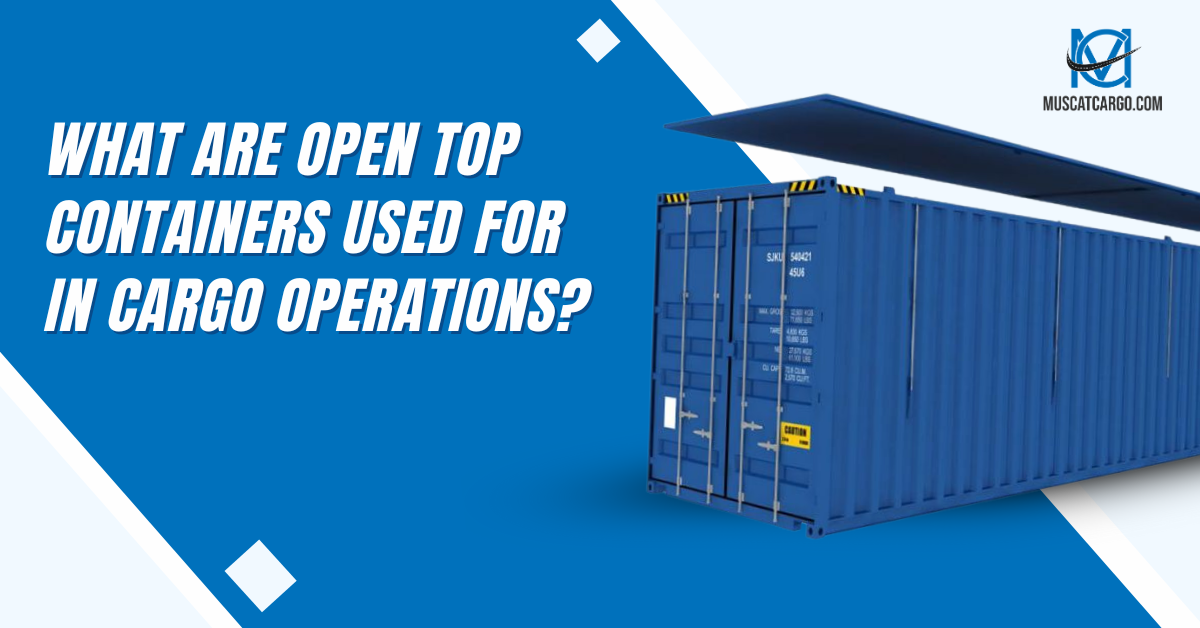
Open-top containers allow cargo to be loaded vertically from above, usually with a crane or hoist. This simple design difference means open-top containers can accommodate goods that are too tall or awkward for a regular container, making them invaluable in the construction, mining, manufacturing, and energy sectors.
Open Top Container Dimensions
Now that we know what they’re used for, let’s talk about size, because dimensions matter in the world of open top container cargo. The standard open-top container comes in two main sizes: 20-foot and 40-foot. But don’t let those numbers fool you. The key distinction lies in the height and flexibility.
A 20-foot open-top shipping container typically measures around:
- Length: 5.9 meters (19.4 feet)
- Width: 2.35 meters (7.7 feet)
- Height: 2.38 meters (7.8 feet)
- Payload: Up to 28,000 kg
The 40-foot variant offers:
- Length: 12.03 meters (39.4 feet)
- Width: 2.35 meters (7.7 feet)
- Height: 2.34 meters (7.6 feet)
- Payload: Up to 26,000 kg
The most noticeable feature is the removable cover roof, supported by removable bows that can be easily dismantled. This allows cargo to exceed typical height restrictions while remaining safely covered during transportation.
Open Top Container Transportation
The journey from warehouse to port to final destination is never simple when it involves non-standard cargo. Open top container transportation is engineered to handle these challenges. Whether it’s a turbine, a steel column, or a large cable spool, open-top containers are personalized for smooth transport of tall, irregular, or extra-heavy goods.
Imagine trying to wedge a 3.5-meter-tall industrial transformer into a regular container. Now, picture the ease of dropping it into an open-top container from above with a crane, securing it with lashing rings, and covering it with a heavy-duty tarpaulin. No struggle, no compromise; just smart logistics at work.
Moreover, the structural integrity of open-top containers ensures your cargo stays secure even during bumpy sea voyages or rugged land travel. Heavy-duty corner posts and reinforced flooring make them as durable as their closed-top cousins.
Open Top Container Logistics
Shipping oversized cargo involves more than just choosing the right container. It’s a logistical chess game. Open top container logistics requires planning every move, from the loading technique to securing permits for over-height transport to ensuring the availability of equipment like cranes at each handling point.
This is where experienced freight forwarders and cargo handlers shine. They understand how to maximize container space, plan efficient routes, and avoid common pitfalls. Open-top container logistics is about strategy, not just storage.
For example, a company is moving industrial boilers from Germany to Oman. The items exceed standard container heights and require special handling. With open-top container logistics, the shipment can be efficiently loaded using overhead cranes, protected with a weather-resistant tarp, and shipped without breaking down the item into multiple pieces, saving time and money.
Why the Open Top Shipping Container is the Hero of Heavy Cargo
It’s easy to overlook the open-top shipping container in a lineup of flashy shipping options. But its humble design offers unrivalled functionality. Where flat racks expose your cargo and require meticulous strapping, and standard containers constrain your load, the open-top container provides a perfect middle ground.
The ability to handle open-top container cargo no matter how tall, odd-shaped, or heavy, without sacrificing safety or efficiency, is a turning point for many industries. From transporting mining equipment to moving long steel rails, the open-top container has proven its worth repeatedly.
With today’s increasing demand for fast, flexible logistics solutions, open-top containers are becoming increasingly popular. Ports around the world now stock them as standard equipment, and logistics teams are integrating them into their everyday operations.
The Future of Open Top Container Transportation in Global Cargo
As global trade evolves and supply chains become more intricate, the need for intelligent container solutions will only increase. Open-top container transportation will play a vital role in accommodating modern cargo’s ever-changing shapes, sizes, and needs.
What sets these containers apart is not just their design, but their adaptability. They serve industries building tomorrow’s energy, construction, infrastructure, aerospace, and beyond. They are often the quiet enablers of progress, carrying the parts and pieces of our most ambitious projects.
From oil fields in the Middle East to skyscrapers in Asia, open-top container logistics has a wide reach. And the more we build, innovate, and explore, the more these specialized containers become central to our journey.
Why Open Top Containers Are the Smart Choice
In the high-stakes world of cargo transport, flexibility is power. Open-top containers provide that power. They eliminate barriers, simplify logistics, and open up possibilities for moving the seemingly unmovable. Whether shipping an oversized crane component across oceans or delivering construction materials to a growing city, the open-top container is not just a shipping option but a logistical advantage.
So, next time you see a ship loaded with towering containers, look for the one without a roof. That’s the open top container quietly redefining what’s possible in cargo transportation.