Businesses experience increasing demands to speed up their order delivery process while maintaining high accuracy levels and reducing expenses. The manual shipping process contains multiple problems which include human mistakes together with delayed order processing and increasing workforce expenses and insufficient real-time tracking capabilities. These operational challenges damage customer satisfaction while simultaneously weakening your market position.
But what if you could eliminate these bottlenecks? Shipping automation serves as a transformative solution which enables businesses to optimize their operations and decrease costs while providing exceptional customer satisfaction. This guide provides a complete overview of shipping automation including its operational principles and advantages as well as Muscat cargo’s implementation of digital solutions and best practices for business success.
What is Shipping Automation? Understanding the Foundation
Manual shipping is slow, error-prone, and resource-intensive.
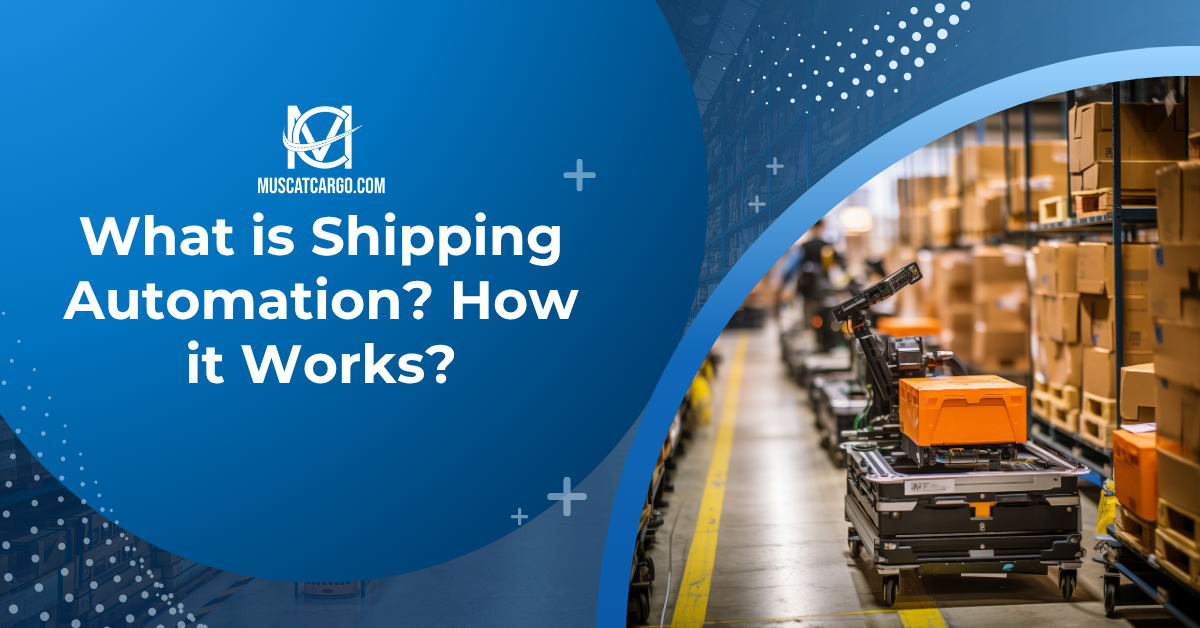
The shipping process receives complete automation through technology which includes software and hardware and digital integration systems. The shipping process includes order import and label generation and carrier selection and tracking and returns management which operate with minimal human involvement.
Every stage of cargo handling at Muscat cargo receives advanced automation and technological integration. Muscat cargo uses robotics and IoT devices and real-time tracking to process your shipments efficiently and accurately while maintaining complete visibility from warehouse to delivery.
Key Features of Shipping Automation:
- Automated order import from eCommerce platforms
- Instant shipping label and packing slip generation
- Smart carrier selection based on cost, speed, and location
- Real-time shipment tracking and notifications
- Automated returns and inventory management
Why Shipping Automation Matters: Addressing Critical Pain Points
Manual shipping operations face three major problems which include high costs and slow deliveries and customer dissatisfaction.
The modern eCommerce industry demands fast and dependable shipping services which also need to maintain complete transparency for customers. Manual processes fail to meet current expectations because they produce delays and errors which result in lost business opportunities. Companies that handle large order volumes and international deliveries face increased pressure.
Muscat cargo provides automation solutions which optimize operations while decreasing labor expenses and reducing human mistakes. Muscat cargo accelerates processing times through automated sorting and packing and labeling tasks which enables staff to move into strategic roles for increased productivity and customer satisfaction.
A retailer operating with manual shipping methods encountered regular order mistakes together with delayed delivery times. The implementation of Muscat cargo’s automated shipping process led to a 30% improvement in order accuracy while reducing delivery times by 40% which enhanced customer retention and reduced operational expenses.
How Shipping Automation Works: The Automated Shipping Process Explained
Lack of visibility and control over shipping operations.
The automated shipping process connects your eCommerce platform with your inventory system and shipping carriers to create a unified seamless workflow. The automated shipping process follows this sequence:
- Order Placement: Customer places an order online.
- The automation software extracts order information immediately without requiring manual data entry.
- The system generates shipping labels and packing slips through automated processes which use product specifications and delivery addresses.
- The system selects the most suitable shipping method automatically through predefined rules that consider cost and speed and regional factors.
- The automated systems perform all tasks related to sorting and packing and labeling.
- The system produces tracking numbers in real-time which get distributed to both customers and internal staff members.
- The automated workflows handle all aspects of returns management including refunds and restocking processes.
The proprietary Warehouse Management System (WMS) of Muscat cargo operates as an automated system to track inventory and manage shipments and documentation. The supply chain partners’ integration enables active data sharing and predictive decision-making during disruptions.
The Benefits of Shipping Automation: Why It’s a Must for Modern Businesses
The process of manual shipping consumes resources while restricting business expansion.
- The implementation of shipping automation systems brings significant advantages to businesses at every scale particularly to eCommerce operations.
- The automation of repetitive work enables businesses to process more orders quickly while maintaining peak season scalability.
- Standardized workflows prevent expensive mistakes that occur during address entry and carrier selection and label printing operations.
- The implementation of automation leads to decreased labor expenses while maximizing carrier rate efficiency and minimizing shipping mistakes that result in return shipments.
- Real-Time Visibility: Track every shipment, analyze performance, and make data-driven decisions.
- The combination of fast accurate deliveries with proactive notifications through automated systems helps build customer trust and loyalty.
The automated systems of Muscat Cargo operate continuously to process and track shipments throughout the day and night. The combination of robotics and AI technology at Muscat cargo minimizes errors while speeding up order processing which creates a competitive advantage for your business.
Shipping Automation Tools & Solutions: Choosing the Right Fit
The main issue lies in finding your way through the numerous shipping automation tools that exist.
Multiple shipping automation tools and solutions exist in the market with different features. Your business selection should match your company size and shipping volume requirements and integration capabilities.
Tool/Platform | Key Features | Best For |
ClickPost | Multi-carrier, tracking, returns, COD reconciliation | eCommerce, high volume |
ShipStation | Label generation, order splitting, SaaS-based | SMBs, online retailers |
AfterShip | Real-time tracking, warranty automation | Global eCommerce |
ShipBob | 3PL, warehouse management, fulfillment automation | Outsourced fulfillment |
Shippo | Multi-carrier, discounted rates, workflow automation | Growing businesses |
ShippingEasy | Automated rules, inventory management, analytics | Multi-channel sellers |
Easyship | 250+ couriers, customs, branded tracking | International shipping |
Veeqo | Bulk shipping, real-time tracking, Amazon family | High-volume sellers |
ShipHero | Warehouse management, AI-powered automation | Large-scale operations |
SendCloud | Label printing, smart rules, returns management | European businesses |
Muscat cargo provides customized automation solutions through the combination of top-tier digital tools with their proprietary systems. The WMS and IoT-enabled tracking system of Muscat cargo provides complete visibility while their expert team tailors automation solutions to meet your specific requirements to deliver the appropriate solution beyond software licensing.
Best Practices for Shipping Automation: Maximizing Results
The implementation of automation systems fails to deliver its intended advantages.
The complete realization of shipping automation benefits requires following these best practices.
- Your eCommerce platform should integrate with inventory management systems and shipping solutions to maintain continuous data exchange.
- Establish specific automation rules to determine career choices and shipping options and notification protocols.
- Real-time dashboards enable you to track KPIs while identifying performance improvement opportunities.
- Your team members need training to understand new workflows and learn how to resolve technical problems.
- The implementation of core automation systems should begin first before expanding to additional features as your team develops confidence.
The Muscat cargo team collaborates with clients to execute automation through phased implementation while offering training and ongoing support and optimization services. Their data-driven approach ensures continuous improvement and rapid ROI.
Muscat Cargo’s Automated Shipping in Action
The regional distributor encountered increasing labor expenses together with regular shipping mistakes when demand reached its peak. The company joined forces with Muscat cargo to establish a complete automated shipping system which combined their eCommerce platform with automated label production and real-time tracking capabilities.
Results:
- 50% reduction in order processing time
- 35% decrease in shipping errors
- 24/7 shipment visibility for both staff and customers
- Improved customer satisfaction and repeat business
Transform Your Shipping with Muscat Cargo
Businesses must adopt shipping automation as a fundamental requirement to succeed in today’s competitive logistics environment. Your shipping process automation enables cost reduction and improved accuracy while delivering exceptional customer experiences.
Ready to revolutionize your shipping?
Muscat cargo offers shipping automation solutions which help businesses optimize operations while cutting costs and creating customer satisfaction. Muscat cargo enables your business to reach its maximum potential through our partnership which brings you into the future of logistics.